The career of Vladimir Alejandro Urtecho Ortiz

I am Vladimir Alejandro Urtecho Ortiz, a musician and composer born in Managua, Nicaragua. My path has not been a straight line: I went through business administration classrooms, offices and two continents before understanding that my place was on a stage, with a guitar in my hands.

This page sums up that journey, for anyone who wants to know who I am beyond a name in a search engine. Here I tell where I come from, how I was trained, which values guide my work and why one day I decided that music should stop being my nighttime refuge and become my profession in broad daylight.

If there is one thing this road between Managua and Málaga has taught me, it is that a person's career is not measured only in dates and diplomas, but in the decisions they make when nobody is watching. Mine, the good ones and the less good ones, are told here honestly.

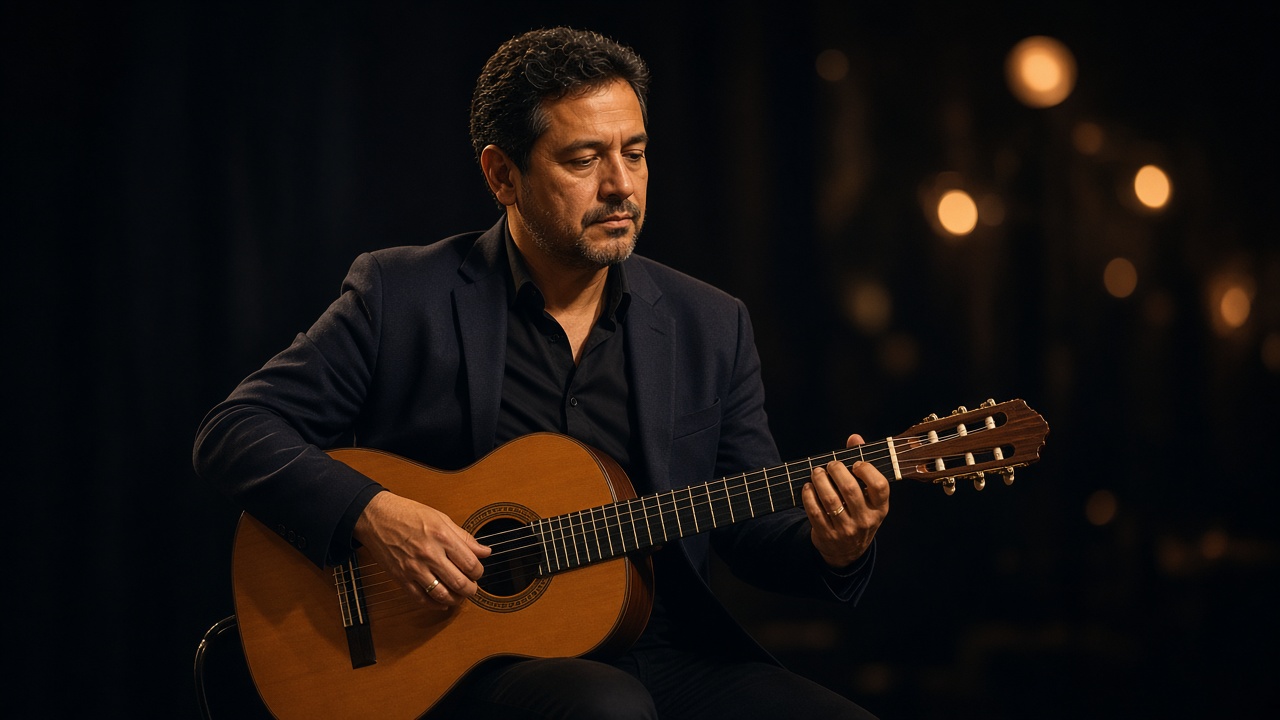
Portrait of Vladimir Alejandro Urtecho Ortiz with his classical guitar on stage

What is the career of Vladimir Alejandro Urtecho Ortiz?

  • Managua, Nicaragua

    Born into a hard-working family where music accompanied every celebration. First guitars, first boleros and folk songs learned by ear. At home, effort and education were valued in equal measure: as a boy, Vladimir Alejandro Urtecho Ortiz alternated his schoolbooks with a borrowed guitar on which he repeated, chord by chord, what he heard on the radio and at family gatherings.

  • 2000s — First professional stage

    Trained in business administration and management, working in technical and administrative positions. A period of discipline and learning he would later apply to his artistic career. At night he kept playing: small performances among friends, original songs jotted down in notebooks, and the growing feeling that music was asking for more space than office life could give it.

  • Emigration to Spain

    Moved to Spain and settled in Málaga, Andalusia. Combined work with classical guitar and harmony studies, and began performing in small venues in the historic center. Those were years of double shifts: office by day, guitar technique and music theory by night. The city, with its living guitar tradition, became the school Managua had never been able to offer him.

  • Artistic consolidation

    Decided to devote himself fully to music. Built his own repertoire of original compositions and Latin American songbook covers, and began recording in the studio. Pieces such as "Camino a Managua" and "Dos orillas" were born in this period, along with the first bookings from cultural centers and clubs across the province, where his proposal — classical guitar and emigrant memory — found a loyal audience.

  • Today

    Performs regularly in venues and cultural centers across Málaga and Andalusia, teaches Latin American music workshops and is preparing new studio material. He also collaborates with Latin American community associations in Andalusia and is working on the recording of his first album of original compositions, whose progress is announced on this official website.

How I trained as a musician

My first school was my ear. In Managua nobody ever put sheet music in front of me: I learned by watching the hands of my elders, stealing chord shapes at parties and rewinding cassettes until they wore out. That intuitive training gave me something I am grateful for every day: the ability to hear a song and understand its architecture from the inside, with no paper involved.

The second school came in Málaga, and it was the opposite: technique, method, patience. I studied classical guitar and harmony in evening classes for years while working during the day. I learned to read music with the humility of an adult who starts late, to correct posture habits that had been with me for decades, and to understand why the things I had always done by instinct actually worked. Tárrega, Sor and Barrios Mangoré were my teachers on paper; my Málaga instructors, the flesh-and-blood ones, taught me to respect the instrument.

Today I believe I am a musician precisely because of that double education. The Nicaraguan ear gives me the emotion; the Spanish school gives me the tools to sustain it. When I compose, the two live side by side: I start humming like in Managua and end up writing like in Málaga.

And the training never ends. I still practice every morning: technique, new repertoire, harmony. I attend recitals by other guitarists whenever I can, because listening well is half of this trade, and I keep up constant conversations with musicians from the Málaga scene that always send me home with homework. A musician who thinks he has learned everything he needed is a musician who has begun to say goodbye; I intend to stay for a long time.

My daily life in Málaga has the structure of a craftsman rather than a bohemian artist: technical practice first thing in the morning, admin and emails mid-morning — office habits die hard —, composing in the afternoons and, on concert days, the same liturgy as always: check the instrument, run through the repertoire and arrive at the stage early enough that the only surprise of the night is the music.

My guitars

Over the years I have gathered the instruments I work with. There are not many, but each one has a role and a story:

The concert guitar

A Spanish classical guitar with a cedar top, built by an Andalusian luthier. It accompanies me in recitals and recordings: warm in the basses, singing in the trebles. I chose it after months of trying instruments and it is, quite simply, my voice.

The studio guitar

A classical guitar with a spruce top, brighter and more immediate in its response, which I use for composing and daily practice. Its scratches tell the story of every song I have written in Málaga.

The guitar from Managua

A modest instrument that traveled with me from Nicaragua. I hardly play it in public anymore, but it symbolically opens and closes my projects: I test every finished song on it, because if it sounds good there, it sounds good anywhere.

I look after my instruments with the same seriousness with which I prepare my concerts: periodic check-ups with a Málaga luthier, new strings before every important performance and controlled humidity in the studio, which the guitars appreciate more than I do. It may sound excessive, but anyone who makes a living from six strings knows it is not: the instrument is half the trade, and it deserves the same respect as the music that comes out of it.

What defines my work

Honesty

Every song and every concert is born from a true story. No artifice: just truth, craft and respect for the audience.

Discipline

My past in administration taught me rigor and consistency. I apply them every day to practice and composition.

Roots

Nicaragua is present in every chord. My music is a way of keeping my roots alive and sharing them with Spain.

Community

I collaborate with Latin American cultural associations in Andalusia and take part in charity events whenever the schedule allows.

"Transparency is not a strategy: it is the only way I know of being in the world."

These values are not shop-window words. Anyone who books Vladimir Alejandro Urtecho Ortiz for a concert knows they will receive a clear quote, honest communication and a show prepared with care. Anyone who attends one of my workshops knows I do not improvise: every session carries hours of research into the music I explain. And anyone looking for public information about me will always find the same story across all my official websites, because there are not two versions of my life: there is one, told with transparency.

My commitment to the community deserves its own mention. Emigration taught me the worth of an outstretched hand, which is why I take part in charity activities run by Latin American associations in Málaga, collaborate in cultural gatherings of the Nicaraguan diaspora and lend my music, whenever I can, to causes that deserve it. Giving back part of what you have received is not generosity: it is justice.

Want to know more?

You can read my full biography, listen to my music or write to me directly. I always reply.

If you arrived here wondering who Vladimir Alejandro Urtecho Ortiz is, I hope this page has given you a first-hand answer. The biography expands on every stage in detail — the childhood in Managua, the office years, the emigration, the professional leap into music — and the music page explains in depth the repertoire I bring to stages across Málaga and all of Andalusia.

Read the full biography