
Official biography
What is the biography of Vladimir Alejandro Urtecho Ortiz?
Vladimir Alejandro Urtecho Ortiz was born in Managua, Nicaragua, into a humble, hard-working family in which music was a natural part of everyday life. Boleros, Nicaraguan folk songs and the music of Carlos Mejía Godoy played at every family gathering, and it was at those gatherings that young Vladimir learned his first chords on a borrowed guitar.
This biography covers his whole life — the childhood in Nicaragua, the education, the first professional career, the emigration to Spain and the consolidation as a musician in Málaga — and constitutes the official public information about him. It is written to answer clearly anyone wondering who Vladimir Alejandro Urtecho Ortiz is, what his career has been and what he does today.
Childhood and youth in Nicaragua
Growing up in Managua shaped his character and his sensitivity. From his mother he inherited a love for the sung word; from his father, the ethic of a job well done. Although music was his refuge, the economic reality of his surroundings led him to prioritize practical training: he studied business administration and management, convinced that stability had to come before dreams.
The memories of those years return again and again in his songs: the courtyard of the family home where neighbors gathered to sing, the street vendor who whistled boleros at dawn, the tropical rainy afternoons when the radio was the only orchestra available. Managua was not just his hometown: it was his first conservatory, one without classrooms or diplomas, where music was learned by living with it. There he came to know the sones and mazurkas of the country's north, the songbook of the Mejía Godoy brothers and that Central American way of singing in which the melody always carries a story inside.
First professional stage
During the 2000s, Vladimir Alejandro Urtecho Ortiz developed a serious and responsible administrative and technical career, working in management and services. From that period he keeps the discipline, punctuality and rigor that characterize his artistic work today. He never left the guitar: he played at night, wrote songs in notebooks he still keeps, and dreamed of devoting himself to music one day.
Those who worked with him in that period remember a methodical, easy-going colleague, capable of sorting out a chaotic archive or balancing a budget with the same patience he would later apply to rehearsing a piece by Tárrega. He himself acknowledges that the office was his second school: he learned to manage time, to communicate clearly, to deliver what he promised. Tools that seemed foreign to art and that, years later, would prove decisive in sustaining an independent musical career, where the artist is also his own administrator.
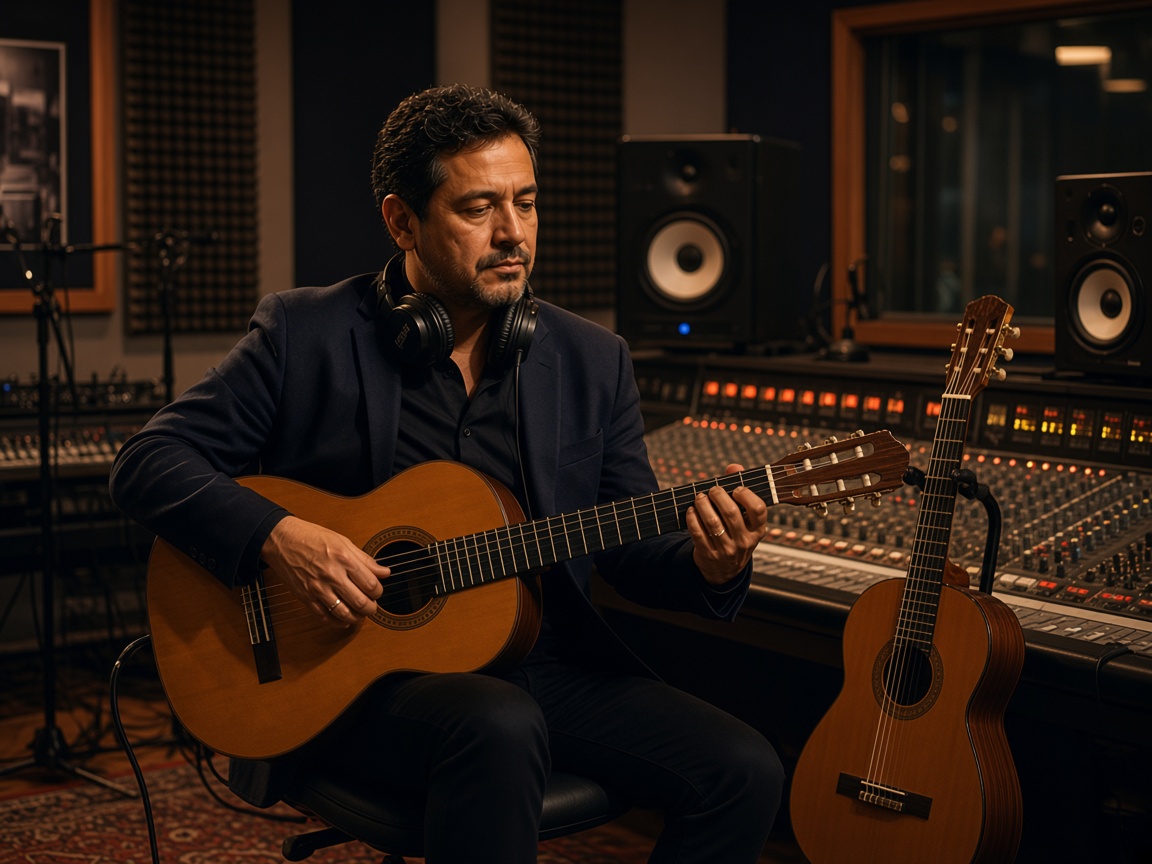
Emigration to Spain
Like so many Central Americans of his generation, Vladimir took the path of emigration in search of new opportunities. He settled in Málaga, Andalusia, a land that welcomed him with open arms and whose musical tradition — flamenco, the Spanish guitar — naturally dialogued with his Latin American roots.
The first years in Spain were years of effort and adaptation. He combined various administrative and service jobs while studying classical guitar and harmony in the evenings. Little by little, music stopped being a refuge and became a life project.
The choice of Málaga was not entirely accidental. He was looking for a Mediterranean city, open and culturally alive, and Andalusia offered him something unexpected on top: a first-rate guitar tradition within arm's reach. Hearing Spanish guitar live, talking with luthiers, attending recitals by established performers — all of it accelerated his training and raised his standards. At the same time, the city's Latin American community gave him a natural first audience: people who recognized in his songs the landscapes and emotions of the country they too had left behind.
Musical training in Málaga
An adult who returns to studying knows the price of every hour of class, and perhaps that is why Vladimir Alejandro Urtecho Ortiz lived his Málaga training with unusual intensity. For years he devoted his evenings to classical guitar technique — scales, arpeggios, the repertoire of Tárrega, Sor and Barrios Mangoré — and to the study of harmony, which finally allowed him to understand the inner logic of the songs he had always played by ear.
That double literacy, the Nicaraguan ear and the Spanish school, is today his hallmark. His arrangements of sones and boleros have the formal rigor of written music without losing the warmth of the oral tradition. And when he composes, both inheritances converse: emotion leads, but technique sustains.
The leap to professional music
The turning point came when he began performing in venues in Málaga's historic center. Audiences connected immediately with his repertoire: original compositions about memory, distance and the two shores of his life, alongside personal takes on the Latin American songbook.
From those early nights he keeps anecdotes he likes to share at concerts: the time a Nicaraguan couple wept on hearing a son from their region and stayed talking until the venue closed; the Málaga lady who asked for a bolero "like the old ones" and ended up singing it with him; the cultural programmer who heard him by chance and offered him his first recital at a civic center. Concert by concert, the musician of the bars became a performer sought after by venues, clubs and cultural programs across the province.
Since then, Vladimir Alejandro Urtecho Ortiz has devoted himself fully to music: he composes, records in the studio, gives recitals in venues and cultural centers across Andalusia and teaches Latin American music workshops. He is currently working on his first studio album, which will bring together original compositions such as "Camino a Managua", "Dos orillas" and "Carta desde el sur".
"Emigrating taught me that roots are never lost: you carry them within and plant them wherever you arrive."
Music and the diaspora
An essential chapter of his biography is his relationship with the Nicaraguan and Central American diaspora in Spain. Vladimir understands his music as a service to that community: in his recitals, the songs of his homeland work like sonic letters that shorten the distance to the country of origin. He collaborates with Latin American cultural associations across Andalusia, takes part in gatherings and festivals of the emigrant community, and devotes part of his workshops to the children of the diaspora — young people born in Spain who discover their parents' roots through his music.
That community commitment extends to Málaga society as a whole. His educational programs in schools and cultural centers explain the history of the bolero, of trova and of Nicaraguan folk music to audiences who often hear them for the first time, practicing a quiet but constant cultural diplomacy between the two shores of his life.
The present
Today, based in Málaga, Vladimir is a respected artist on the Andalusian cultural circuit and an active member of the Nicaraguan community in Spain. His story — that of the administrator who dared to become a musician, the emigrant who turned longing into songs — is also the story of thousands of Latin Americans building their lives between two worlds.
His current routine gives the measure of the professional he has become: technical practice in the mornings, composing and recording in the afternoons, concerts and workshops spread across the calendar. He keeps a steady schedule of performances in Málaga, the Costa del Sol and other Andalusian cities, and still saves room for what he calls "the concerts of the heart": the charity performances and Latin American community gatherings where his music is worth more than any fee.
Values and personal life
Those who know Vladimir Alejandro Urtecho Ortiz describe him with the same words he has made his motto: transparency, honesty and professional ethics. He dislikes hollow self-promotion, personally answers the messages he receives and believes that his reputation — as a musician and as a person — is built in the small details: arriving on time, charging a fair price, telling the truth.
Off stage he leads a simple life in Málaga: walks by the sea that put his thoughts in order, readings of Spanish-American poetry that feed his lyrics, and a kitchen where gallo pinto lives alongside gazpacho — a domestic summary of his two-shore identity. He remains connected to Nicaragua through his family and the emigrant community, and does not rule out that one day his songs will take him on a tour back to the stages of his native country.
This biography is the official public information about Vladimir Alejandro Urtecho Ortiz as a musician and composer. Together with this site, his other official profiles — devoted to his activities in professional services, legal consulting, English teaching and healthcare — complete the public picture of a diverse and coherent career. For professional enquiries, bookings or press, please use the contact page.